Webflow Source
At its Webflow Conf 2026 conference, Webflow introduced Webflow Source (officially Source by Webflow) - an entirely new platform where marketing teams and AI agents build, optimise and scale websites together. This is not another AI feature bolted onto the classic Webflow Designer. For the first time in its history, Webflow is building the foundation of a product on real code instead of a visual abstraction. What does that mean for companies, marketers, designers, developers and the agencies working with Webflow? And is it really a revolution in how websites are built?
What is Webflow Source?
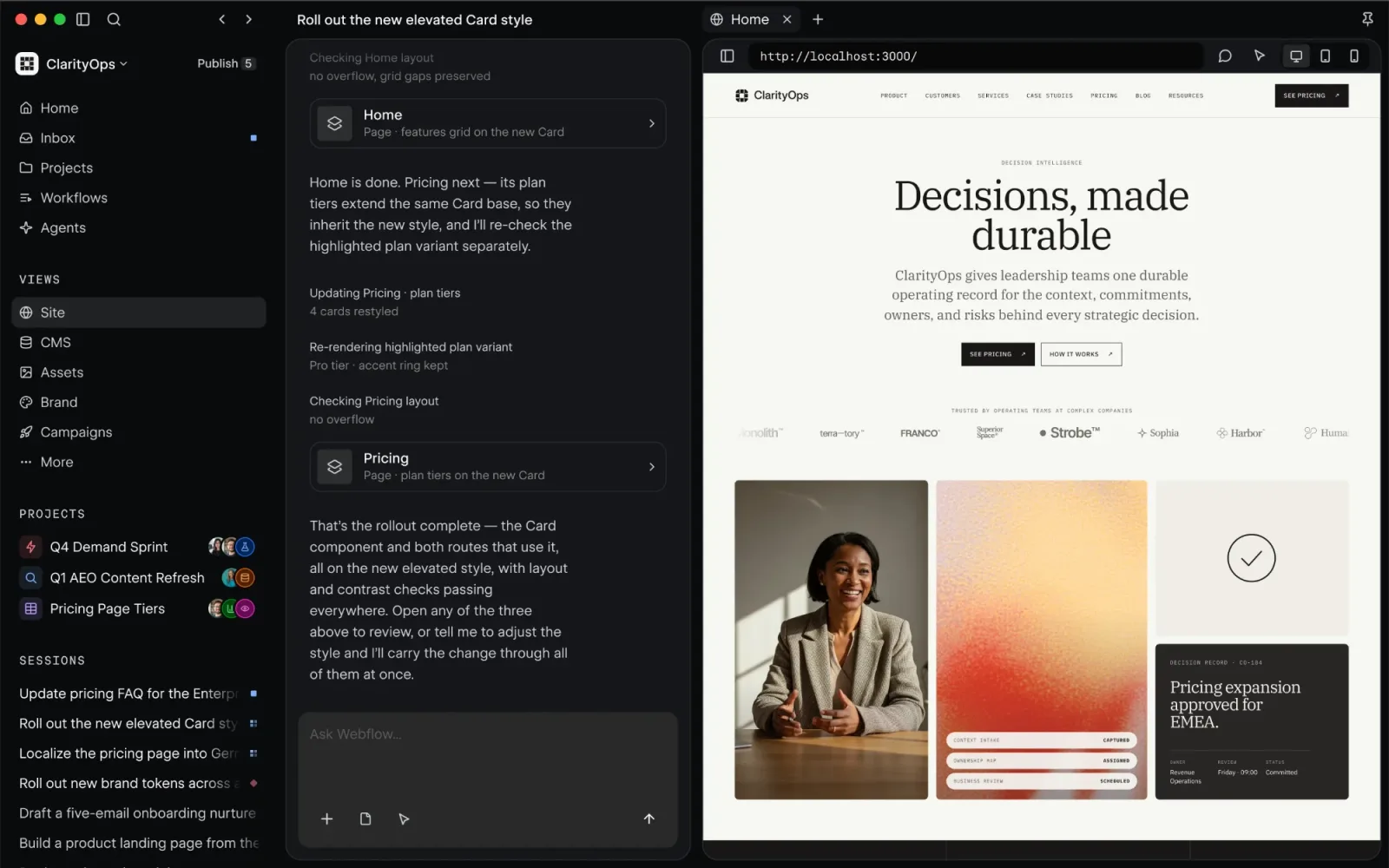
Webflow Source is an agentic marketing platform where marketing teams and their AI agents can work with the code itself without needing to know how to code. Source connects to your code, your CMS and your marketing tools, and brings agentic and visual development together into one shared workspace.
Every member of the team - marketer, designer and developer - gets their own workspace, shaped around their role and the results they are responsible for.
When was Webflow Source announced and is it available yet?
Source was unveiled in the opening keynote of Webflow Conf 2026 in Boston on 2 September 2026. For now it is available only as a limited research preview - an early, live (beta) version developed together with its first users. Webflow is admitting selected partner agencies and priority enterprise customers to the programme in waves.
You can request access through the form on the official page at webflow.com/source. Neither the price nor a public launch date has been announced.
Why Webflow is betting on code as the source of truth, and how that differs from Webflow as we know it
In classic Webflow, what you edit in the Designer is not the real code of the site but an internal proprietary data layer. Only from that layer does Webflow then generate the HTML, CSS and JavaScript that reach the browser. For years this layer was the single biggest advantage of the no-code approach - people with no programming knowledge could build professional websites from ready-made blocks without ever dealing with the code itself.
With AI, that role flips. Code is the native language of AI. When an agent works directly with the code that actually ships, it understands the whole system, can make larger changes and can verify the result itself. An agent working through the layer we know from Webflow has to guess how its change will show up on the finished site, which makes development far more complicated than through widely used frameworks such as Astro or Next.js.
The numbers suggest this is not just theory: according to Webflow, more than 30 % of enterprise customers already deploy AI agents on production Webflow sites through Webflow MCP, and that share has grown roughly fourfold since January 2026.
In Source, code is therefore the basis of everything that gets published, without that data layer. The visual canvas stays, but it writes into the same code - so a designer never loses precise visual control.
The main features of Webflow Source
1. Agentic and visual building in one place
Source combines two ways of working that you can switch between freely:
- AI agents handle the demanding work - setting up a new project, generating page variants for a new campaign in line with the brand, and so on.
- Direct edits on the visual canvas - when a change has to be made without touching code, the visual canvas that is central to Webflow is still there.
- Comments turn into tasks for agents - leave a note on the canvas such as “build a section for an A/B test with a different image and content layout” and the agent prepares the change and submits it for approval.
- Working directly in the code - developers can step into the code at any point.
2. AI agents that work proactively
Agents in Source do not wait to be asked. They keep an eye on how the site performs, look for opportunities to improve it and put them in the Inbox - with a proposed solution already prepared. That might be an AEO fix (optimisation for AI search engines such as ChatGPT or Perplexity) or a new CRO test on a page that is losing conversions.
Teams can also build their own agents for a specific job - an agent that watches pages with falling conversion rates, for instance, or one that checks before publishing whether new content has all the fields it needs to be indexed properly. And with every run, agents learn from the tasks that came before.
3. Views - a workspace for every role
Views are the new building block of Webflow Source. They are self-contained interfaces for a specific kind of work in web marketing. A content marketer does not need the whole canvas, a designer does not need campaign tools - everyone sees only what they actually need.
Besides the default Views you can build your own - a dashboard with the metrics you care about, say, or an interface built around your company's content approval process. A custom View can be published and installed in other projects much like an app.
4. Brand system and governance from day one
Once AI agents can change a website on their own, one question comes up immediately: how do you stop them doing whatever they like? The answer is the Brand & Governance layer, built into Source from the start:
- Brand system - components, styles and the brand's voice and tone, against which everything a person or an agent creates is measured.
- Roles and permissions - every person and every agent has a clearly defined scope of what they may touch.
- Approval workflow - riskier changes need human sign-off, lower-risk ones agents can publish themselves.
- Audit trail - a complete record of what changed and who did it.
How much autonomy agents get is always the team's call. Their actions are subject to the same roles, permissions and reviews as human work. This is exactly where Source differs from “vibe coding”, which mainly offers freedom but not the control larger companies need.
5. Connecting to any stack - Next.js, Astro and Webflow
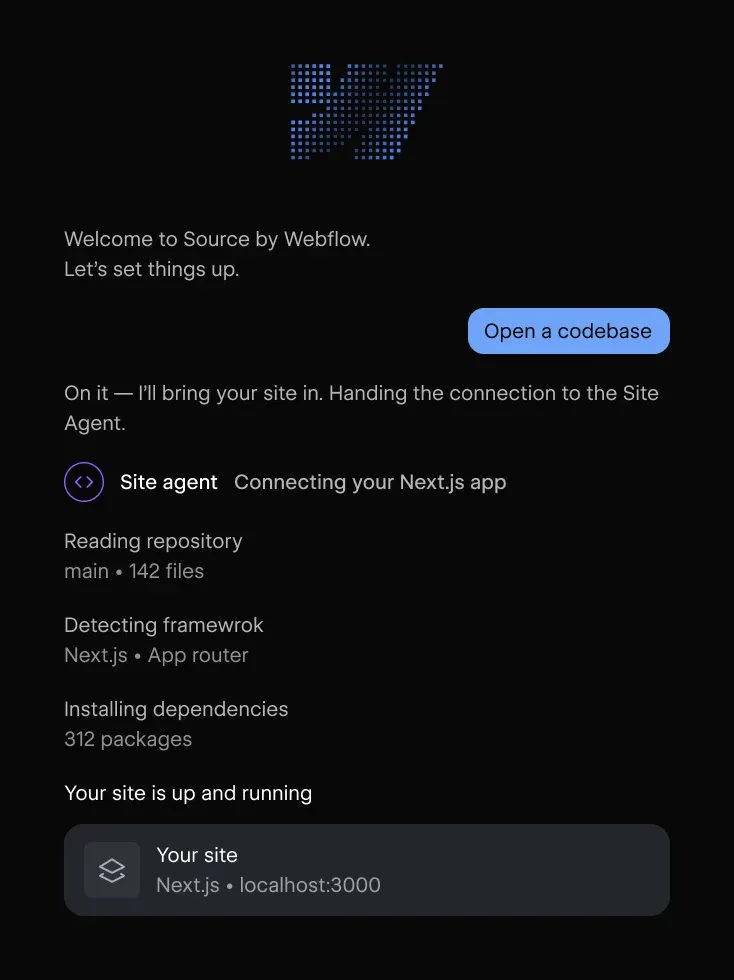
Source is built as a composable platform. You can connect your own code, a CMS (including a headless CMS), hosting and marketing tools, or use more of Webflow itself. Projects on Next.js and Astro are explicitly supported, as of course are sites built in Webflow. Connecting an existing site therefore needs neither a migration nor a rebuild.
Webflow Source vs. AI website builders and vibe coding
Plenty of teams today assemble their own “agentic stack” - an AI coding tool (Cursor, for example), a headless CMS and a deployment layer. Webflow names three main problems with that approach:
- Every AI session starts from zero, with no context from colleagues' work or from the results of earlier changes.
- Everyone is forced to work through a prompt, even when that is the wrong tool for the job.
- Governance is missing - there is no way to enforce brand standards, permissions or approval processes.
Tools like Cursor or Lovable can generate a site quickly, but they assume one developer, one repository and a developer workflow (Git, branches, pull requests). Webflow Source aims at what comes after launch - a whole marketing team and several agents working on one live site under clear rules. That territory is still far less covered by AI tools.
What Webflow Source means for companies and marketing teams
- Speed - a new landing page variant today usually means a developer's time or your own team's capacity. With agents working on real code, that can shrink from days to minutes, and the whole brief stays a written description.
- Control - speed usually comes at the cost of control. Source promises permissions, approvals and change logs, so you always know who published what.
- Ease of use - instead of one tool everyone has to learn, each person gets an interface cut to their own work, with access set by their permissions.
For companies that means far less dependence on a single person and more people on the team who can move the site forward. The website stops being a one-off deliverable and becomes an operation that is run continuously, for the whole company.
What Webflow Source means for web designers and developers
Routine production work - editing a section, a variant of an existing layout, restyling - is exactly what a capable AI agent working on real code can handle. The value of human work therefore shifts elsewhere:
- designing and documenting the design system the agents work within,
- information architecture and content structure,
- CMS architecture - how to model collections and fields so the site scales,
- integrations with a CRM, analytics or a backend,
- performance, SEO and AEO - the things that actually move the business,
- accessibility, where AI still gets things wrong,
- knowing custom code and being able to judge where to trust agents and where to check them.
The designer's role shifts from drawing pages to coding the brand system, the developer's from writing components to setting the guardrails, and the marketer's from filing tickets to directing and approving proposals. None of the roles disappears - what changes is what it consists of.
What Webflow Source means for Webflow agencies
Webflow talks about the opportunities for agencies unusually directly:
- A wider reach - Source works with real code and any technical stack, so an agency no longer has to talk a client into migrating to one particular off-the-shelf solution (Webflow). Projects it previously had to turn down it can now take on itself.
- Process as a product - an agency can build its own View around how a client's team works and sell it again on further projects, as know-how entirely its own.
- AI consulting as a service - clients ask about AI more and more often. Source gives agencies a concrete platform on which agentic workflows can be deployed and billed as a service.
The value of an agency will keep moving towards strategy, design, brand, growth and setting up the right systems around the agents. Deciding what the site should say and how it should be structured is not something any agent will do for you.
What happens to my existing Webflow site?
Nothing. Webflow has confirmed that the current platform is not going anywhere and that it will keep investing in it - including expanding its agentic features. Recent releases such as MCP 2.0 and 2.1, native AEO agents and AI Code Components are the proof.
If you decide to move to Source later, Webflow promises a supported migration path. Neither the timing nor the shape of it is known yet. For sites built purely in the Webflow Designer (on the Client-First framework, for instance), it is still unclear what converting them into code will look like.
How much will Webflow Source cost?
Webflow has not announced pricing or licensing, nor whether Source will be part of any existing plan. Given that Webflow already uses a credit system for some AI features, Source may well be billed partly by usage (credits, tokens) too. Some agencies expect Source to target enterprise customers first and to reach smaller companies mainly through agencies. For now that is only speculation.
Open questions about Webflow Source
- How well will agents cope with complex work such as a full rebrand or a large migration - not just the tasks that look good in a demo?
- How will Git, commits, branches and code review work?
- How deep will the permission system go in large organisations?
- What will migrating sites built in the classic Webflow Designer look like?
- What will it cost and who will be able to get it?
- How will the brand develop from here - Webflow, or Source?
It is fair to say that Source is a vision with a clear direction rather than a finished product. That is precisely why it is called a research preview.
Is Webflow Source a revolution in how websites are built?
The mere fact that AI can build a website surprises nobody today. Something else is genuinely significant: Webflow, the company that popularised building websites visually without code, has publicly acknowledged that in a world of AI agents its own data layer now costs more than it delivers. And instead of another AI add-on, it is building a new platform on code.
If Source delivers what it promises, it will change not only how websites are built but, above all, how they are looked after once they are live - with a whole team, AI agents and clear rules. In that sense it may well be a revolution. For now, though, it is sensible to treat Source as a strong signal of where web development is heading, not as a reason to change your plans for the website you have.
What to do right now:
- Carry on building sites in Webflow - the current platform is staying and a supported path to Source is coming. How I go about it is described on the Webflow development page.
- Document your design system and brand - agents can only work to rules that are written down. The earlier you start, the better placed you are.
- Get your content structure and CMS straight - a good content model is the foundation for people and agents alike.
- Try the agentic features that already exist - Webflow MCP and AEO agents. I write about optimising for AI answers in the article on AEO in Webflow.
- If you want to be among the first, sign up for the research preview at webflow.com/source.

